
On 20 October 2026, the MMinE-SwEEPER project hosted its second webinar, focusing on munition detection, removal and disposal methods. Bringing together representatives from research institutions, industry, government agencies and the defence sector, the event showcased innovative detection technologies, practical applications and ongoing initiatives addressing the challenges of underwater munitions.
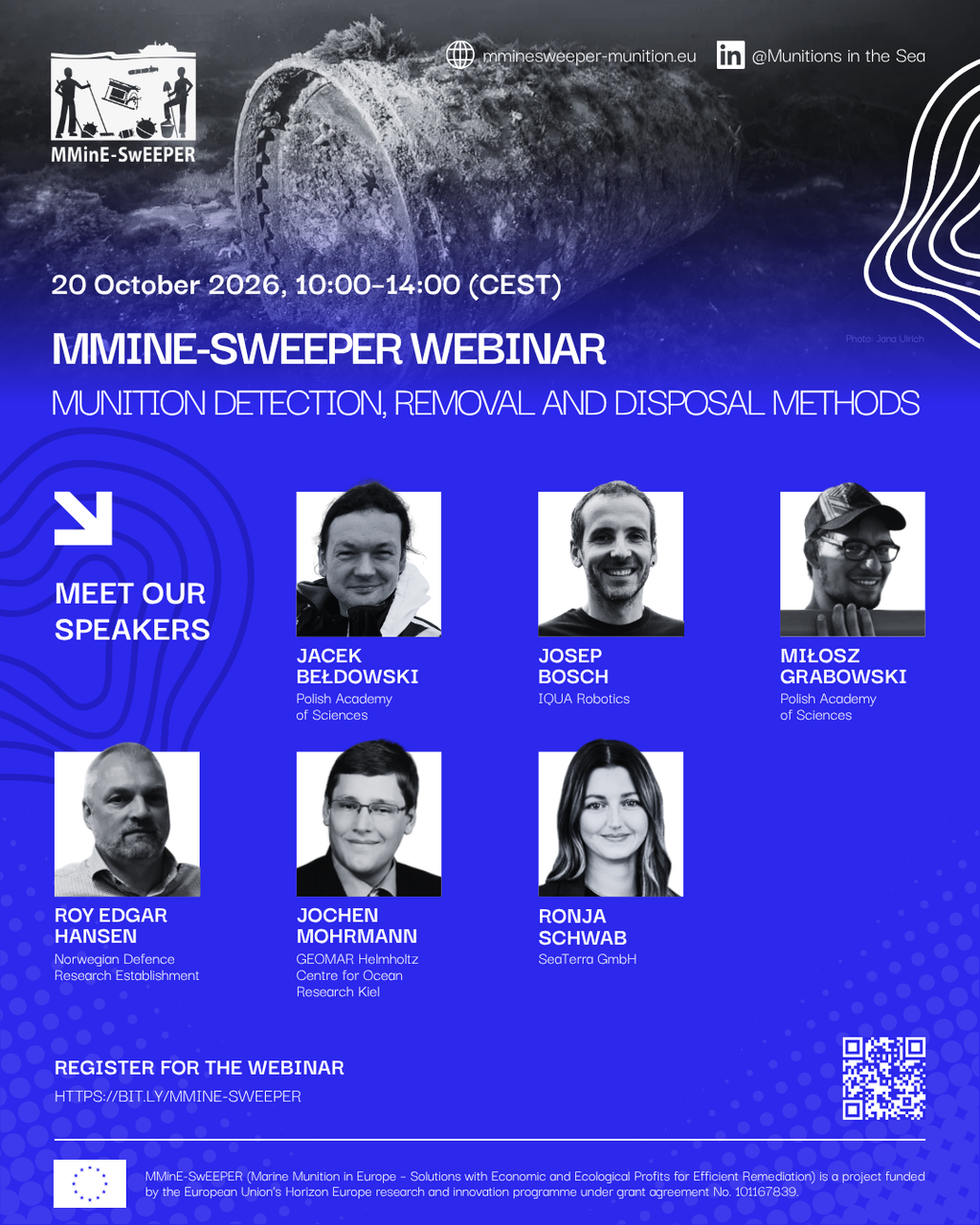
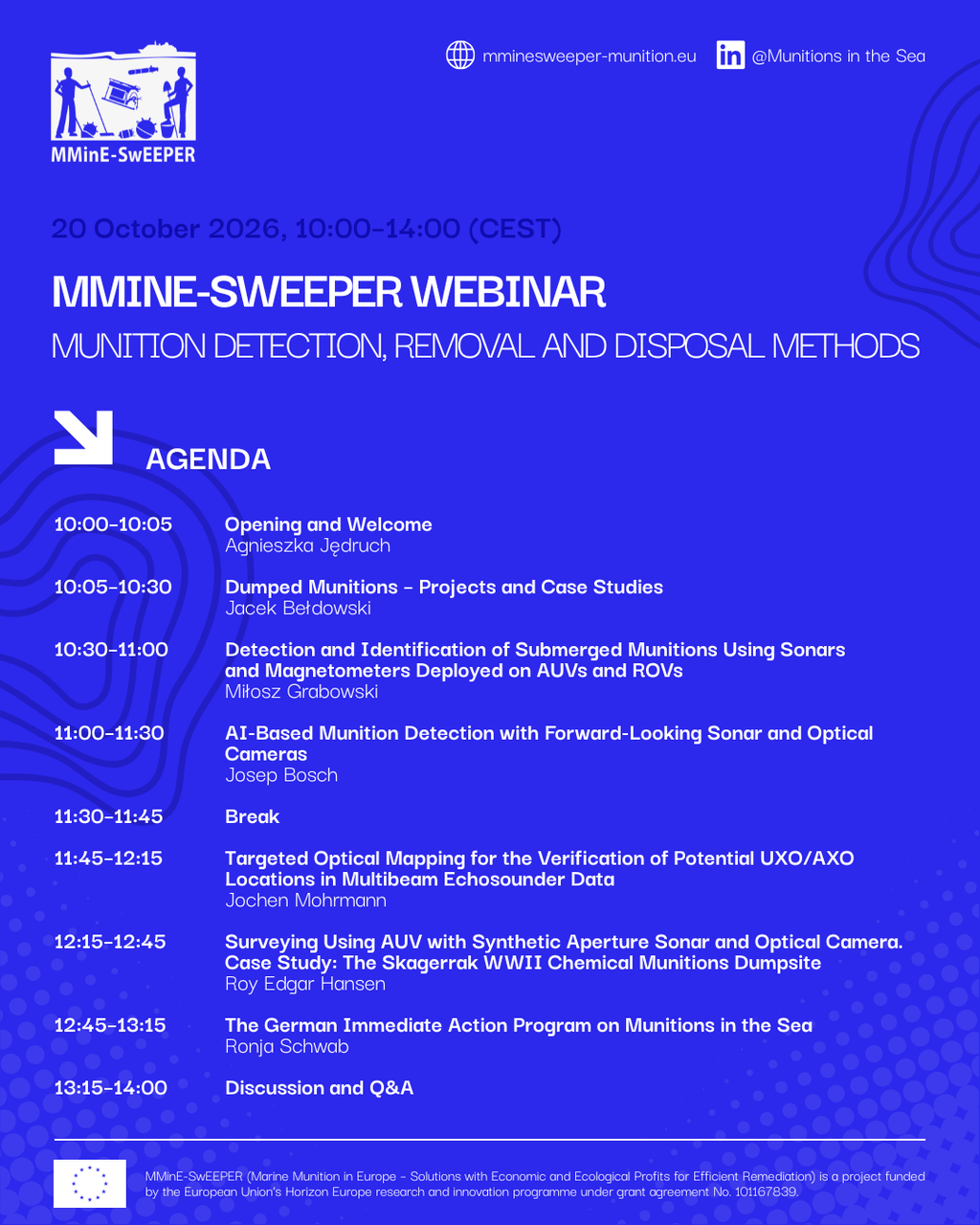
How can we better detect, identify and manage munitions lying on the seabed? From AI-powered detection systems to autonomous underwater surveys and large-scale national initiatives, the second MMinE-SwEEPER webinar, held on 20 October 2026, explored a range of technologies and approaches aimed at tackling this complex challenge. The webinar was organised within Work Package 11: Integration of Best Practices and Development of Educational Material, led by the Institute of Oceanology of the Polish Academy of Sciences (IOPAN). The programme featured six presentations delivered by experts from research institutions and industry, covering a broad range of topics related to underwater munition detection, identification and management. The webinar opened with Jacek Bełdowski (IOPAN), who provided an overview of projects and case studies related to dumped munitions, highlighting ongoing research and international efforts to address this environmental challenge. The following presentations focused on technological developments in underwater munition detection and identification. Josep Bosch (IQUA Robotics) introduced AI-based munition detection using forward-looking sonar and optical cameras, while Miłosz Grabowski (IOPAN) discussed the use of sonars and magnetometers deployed on autonomous underwater vehicles (AUVs) and remotely operated vehicles (ROVs). Jochen Mohrmann (GEOMAR Helmholtz Centre for Ocean Research Kiel) presented targeted optical mapping for verifying potential UXO/AXO locations identified in multibeam echosounder data. Moving from detection technologies to practical applications, Roy Edgar Hansen (Norwegian Defence Research Establishment) presented a case study from the Skagerrak WWII chemical munitions dumpsite, demonstrating the use of an AUV equipped with synthetic aperture sonar and an optical camera for underwater surveys. The final presentation was delivered by Ronja Schwab (SeaTerra), joined by Dieter Guldin (SeaTerra) as a guest speaker. Together, they introduced the German Immediate Action Programme on Munitions in the Sea, providing insights into ongoing national efforts to address the challenges posed by underwater munitions. The presentations were followed by an open discussion and Q&A session, providing an opportunity for participants to exchange experiences, ask questions and explore different approaches to munition detection and management. The webinar attracted over 60 participants from across Europe and beyond, reflecting the global relevance of the challenges associated with submerged munitions. It highlighted the importance of combining technological innovation, scientific expertise and practical experience, as well as the value of knowledge exchange and cooperation between research institutions, industry and public authorities. Missed the webinar or want to revisit the presentations? Watch the recording on our YouTube Channel Munitions in the Sea: https://www.youtube.com/watch?v=WJKt3Vlzuoo.