Underwater crawlers are autonomous or remotely operated vehicles designed to steadily travel along the seabed and shallow coastal shelves and slopes. The earliest documented subsea crawler was the ‘Remote Underwater Manipulator’ (RUM), which was designed for scientific usage and assembled in 1958 at Scripps Institution of Oceanography (USA). RUM was driven by two heavy electric motors in an oil-filled container and 8000 m cable, and fitted with a durable steel claw which could reach out and retrieve objects ~5 m any direction. Eventually a light, sonar and 4 waterproof cameras were installed to supplement its utility. RUM essentially completed one of the earliest documented deep-sea clean-ups by successfully selecting and recovering a discarded tomato can off the ocean floor, which was home to a very small and frightened octopus.
Crawlers have come a long and not-so-long way since then. They are excavators in nature, moving via treads or wheels, and providing stable, mobile platforms for subsea inspection and installation, maintenance, surveyance, and object intervention and transfer. Most heavy marine crawlers are used for digging trenches or maintenance and construction, especially cable and pipe placement and repair, in the offshore energy sector. For example, Royal IHC (Netherlands) provides multiple specialized underwater crawlers for nearly every type of cable.
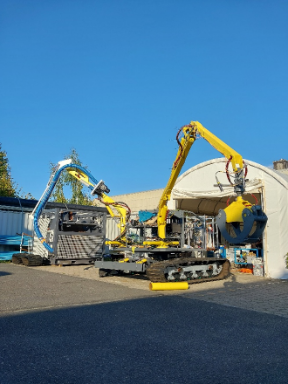
Somewhat inspired by the “Minserner Oog” project, where for the first time a heavy crawler was deployed for ordinance removal, SeaTerra is building a 5-ton ‘UXTractor’ for use as a mobile and broad underwater platform for the purposeful collection and transport of submerged munitions, including those of large caliber or with irregularly corrosion. The designated objective was to create a ‘grabbing system’, and with this crawler SeaTerra will deliver an closely integrated system, combining a platform with multi-modal sensor arrays, real-time visualization, hydraulic actuation, as well as two separate arms; one for dredging and magnetometry, and the other for targeted munition grabbing. Specifically the arms have been modified from forestry harvester cranes, optimized for greater operational flexibility and improved stability while lifting and handling suspended loads up to 800 kg within intense and dynamic underwater currents, such as those throughout the North Sea.
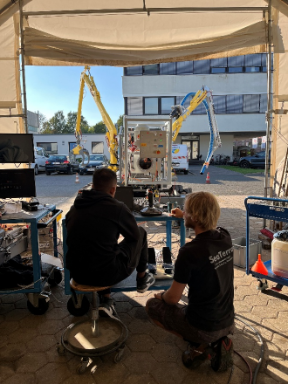
The UXTractor is currently being assembled piece-by-piece in SeaTerra’s busy and cramped lot. Its primary base and hydraulics are installed, and functional testing is now taking place once each necessary piece is set, concurrently for physical mobility and all accompanying, controlling software. Next on the list will be grasping trials using various grabbers and surrogate targets. Technically and eventually the two independent 25 kW hydraulic 2-speed motors will enable the crawler to drive underwater up to 8 km/h and climb slopes of 25o, while also maneuvering 360o zero-radius turns. The UXTractor will be equipped with 7 HD Cameras, ARIS Sonar and a magnetometer, connected via a 900 m steel-armored electro-optical cable which is able to transmit multi-sensor data directly to the EOD monitors as they sit comfortably focused within their ship-board control housing. The future of munition clearance is coming soon, just in time to shift away the past.