
Following our earlier news article on the stakeholder workshop held during the 2025 Kiel Munition Clearance Week in Germany, the results of these discussions have now been published. The workshop, organized in collaboration with the MMinESwEEPER, MUNI-RISK, and MUNIMAP projects, brought together experts to assess current knowledge on submerged munitions in European seas, identify information gaps, and examine challenges related to risk assessment and legal frameworks. Discussions were facilitated through World Café sessions and supported by real-time audience engagement using Mentimeter.
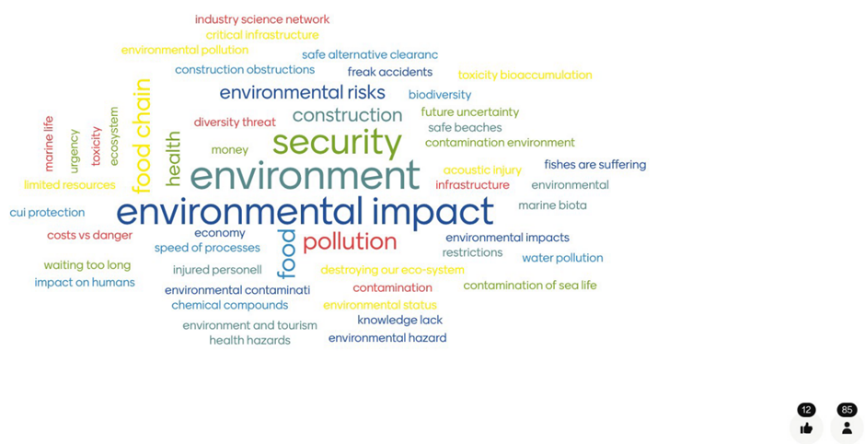
Stakeholders expressed significant concern about the impacts of submerged munitions on the environment, critical infrastructure, security, and public safety. Environmental risks dominated the dialogue, with strong emphasis on pollution, ecosystem degradation, and threats to environmental health (see Fig 1). As a result, participants identified five principal criteria for prioritizing remediation efforts: environmental impacts, proximity to critical infrastructure, social well-being, security risks, and the corrosion state of munitions. Sensitive ecological areas, such as fish spawning grounds and marine protected areas, were considered top priorities for intervention. Areas containing essential or planned infrastructure e.g., wind farms, subsea cables, pipelines, shipping lanes, and ports e.g., were also viewed as requiring urgent consideration. Social concerns centered on tourism, seafood quality, and public safety, while security concerns focused on preventing the potential recovery or misuse of munitions.
Stakeholders stressed the importance of conducting comprehensive Environmental Impact Assessments before any remediation activity. Key EIA components should include biodiversity assessments, contamination evaluations, munition condition surveys, site specific environmental parameters, and safety risks such as underwater noise and sediment resuspension. EIAs should also draw upon historical records, regulatory documents, and insights from nearby infrastructure assessments, and examine disposal methods and local technical capacities. Participants highlighted the need for harmonized EIA standards across projects and jurisdictions to ensure consistent evaluation.
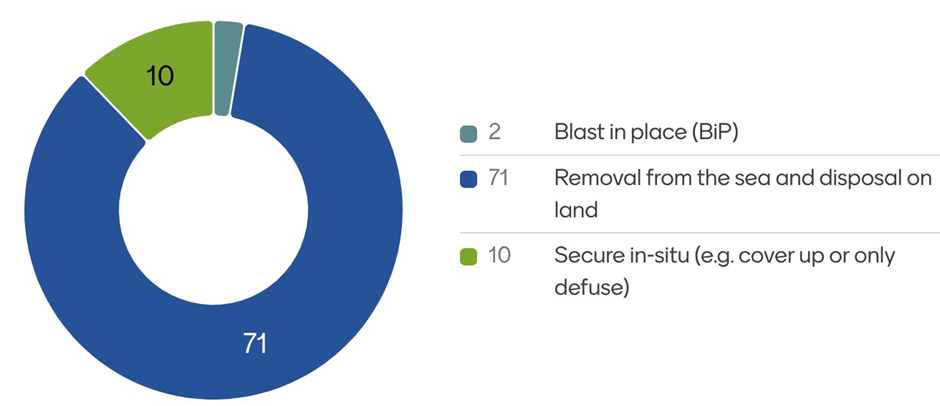
In terms of remediation drivers, environmental protection was seen as the strongest motivation, followed by security and cost considerations. Stakeholders favored removing or safely securing munitions rather than using blast in place approaches (see Fig 2). However, they noted that while environmental concerns are the most important motivator, they are often the least feasible to address in practice. Major barriers to remediation include uncertainty over responsibility for costs, gaps in national legislation, and unclear decision-making processes.
Participants also identified serious safety, environmental, and operational risks associated with remediation, underscoring the need for shared responsibility between contractors and regulatory agencies. Legal challenges further complicate remediation efforts, including inconsistent permitting processes, unclear institutional responsibilities, limited political commitment, and outdated regulations. Stakeholders differed in their preferences for future legal frameworks, with some favoring national approaches, others advocating for new EU or international frameworks, and a third group supporting harmonization of existing laws.
The findings of this study offer insights relevant to the EU Oceans Pact, particularly its priority to develop a comprehensive strategy for removing submerged munitions from European waters, beginning with the Baltic and North Seas.
Photo credits: publication
Frank Akowuge Dugasseh, Delove Abraham Asiedu, Maria del Rosario Dominguez Carrasco, Andriy Martynenko, Agnieszka Jędruch, Anita Künitzer, Jacek Bełdowski, Hans Sanderson (2026): Synthesizing stakeholder knowledge on submerged munitions in the Baltic Sea: Insights from World Café and Mentimeter engagements, Marine Pollution Bulletin, Volume 227, 119429, ISSN 0025-326X. https://doi.org/10.1016/j.marpolbul.2026.119429