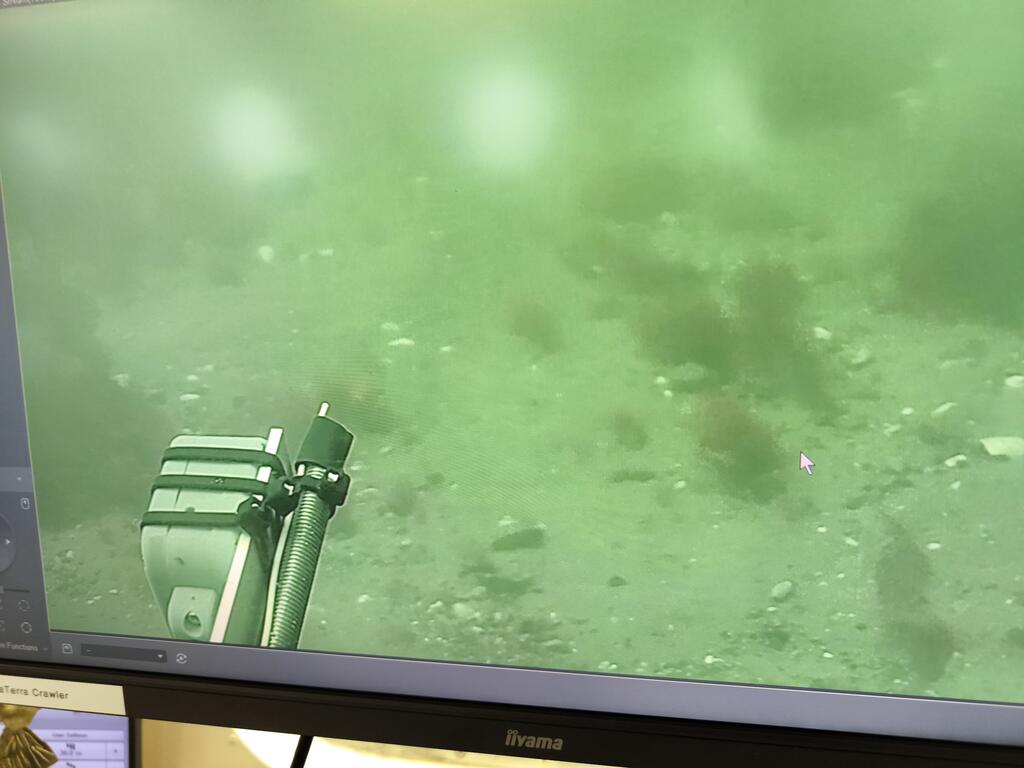
As munitions decay, miniscule amounts find their way in surrounding waters. The miniaturized Fraunhofer ICT submersible sensor system can quantify those traces of explosives electrochemically. Mounted on submersible vehicles, it can provide high data rate electrochemical information on surrounding waters, enabling identification and thus remediation of explosives.
A pivotal goal of the MMinE-SwEEPER project is to enable and improve effective remediation of unexploded ordnance (UXO) underwater. Prior to remediation comes the challenging task of locating supposed UXOs and identifying contained substances. These steps are crucial for safe and effective disposal operations.
As UXO decay, miniscule amounts of its contents may be released during its time on the sea floor. Those contaminants can be identified analytically in the lab or in-situ and give important information about type of the explosive material still contained inside the hull. This knowledge helps disposal experts identifying UXO origin and condition of hazardous materials, enabling them to pinpoint, plan and prioritize remediation areas efficiently.
Also, the distribution of contaminants in sea waters is of great interest to toxicologists and marine biologists, as chemical data helps experts quantify the environmental impact of UXO disposal.
This gave motivation to accelerate this important identification and analysis step during MMinE-SwEEPER. A team of engineers and researchers at Fraunhofer ICT developed a novel submersible sensor system, enabling first time live and in-situ detection of explosive traces. Operation of the system is comparable to a tracking dog - but works underwater. Its electrochemical working principle analyses and identifies trace amounts of explosive substances down to µg/l scale.
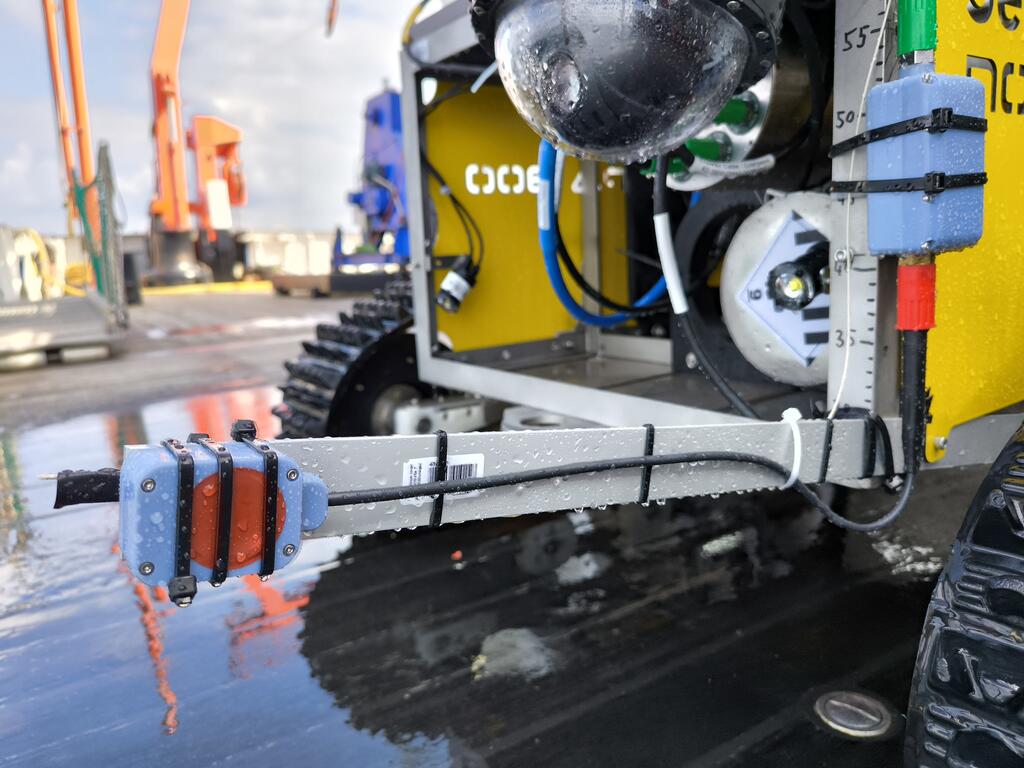
Each component of the system was custom developed at Fraunhofer ICT. State of the art masked stereolithography (MSLA) 3D-printing enables production of pressure proof housing in less than two hours. The custom electronics is compatible with multitude of submersible vehicles. The compact system consists of two modules – an electronics compartment and a sensor compartment. It can be mounted easily on any submersible vehicle e.g. rovers or submersibles and stationary systems as platforms or lander systems. A specialized software, running on the sensor system itself, can autonomously operate the system and evaluate measurement results.
Concluding, the system enables large area scan and monitoring operations for explosive compounds concentrations. The development proves the miniaturization, production and application of electrochemical detection systems in submersible applications. This displays a significant improvement of in-situ measurement technology for explosive compounds in seawater, as first time experts are enabled to measure live concentrations of contaminants.
The system was already deployed successfully two times during MMinE-SwEEPER operations on different submersible vehicles. Planned future tasks aim to get a better understanding of system operations and further demonstrate system usability of this novel submersible electrochemical sensor system.