At Cranfield University, UK, we pride ourselves on delivering research-led teaching, specifically our Maritime Underwater Munitions 5-day module. This course enables students to learn from real experimental work, presentations from leading academics and practitioners from across Europe. Students have the opportunity to attend a short course for credit or as a standalone participant.
The Maritime Underwater Munitions 5-day short course at Cranfield University, UK, provides a unique opportunity for professionals and students to explore the challenges associated with underwater warfare, sea-dumped munitions, mine countermeasures, environmental impacts, and the future of maritime security. The course is delivered annually at Cranfield University based at the Shrivenham campus at the Defence Academy of the United Kingdom. The course combines lectures, workshops, industrial visits to maximise learning objectives and wider networking. This module is also part of the Explosive Ordnance Engineering, MSc.
A key feature of the course is its strong emphasis on research-led teaching. Rather than relying solely on established knowledge, we integrate current research projects, operational experience and real-world case studies directly into the teaching of the course. This allows participants to engage with the latest scientific developments and understand how research informs policy, safety and environmental management and operational decision-making. Last year, we welcomed guest speakers from the public sector and private companies across the UK, Germany and Italy. Their contributions provided a valuable international perspective on the challenges facing the maritime domain today, from underwater threats and mine countermeasure operations to environmental monitoring and remediation.
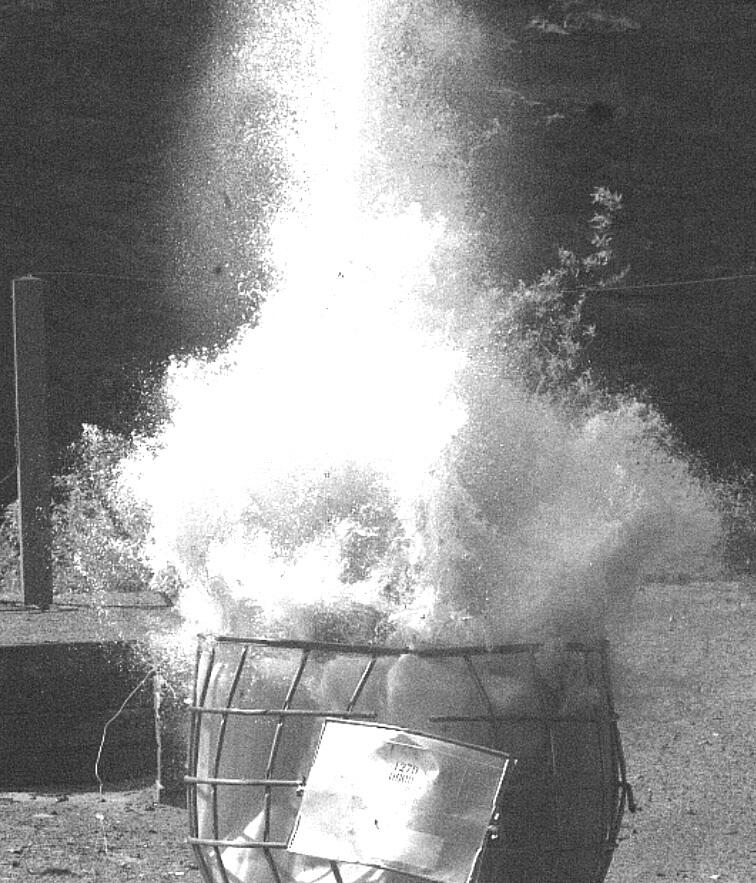
Another example of how research informs our teaching is our recent experimental work investigating the environmental impacts of low-order detonations of munitions which is currently part of the experiments to inform MMinE-SwEEPER. We tested pipe bombs, replicating world war munitions, containing TNT and Composition B (Comp B). Water and sediment samples were collected following detonations to determine how much explosive material remains in the environment and how these residues behave once released.
This is important due to increasing interest in understanding the environmental consequences of munitions disposal and clearance activities in marine environments also because of the current guidelines looking into using low order techniques more compared to the high order, due to the minimised physical impact. The data collected will help improve our understanding of the fate of explosive compounds after detonation and contribute to future environmental risk assessments by understanding the chemical contamination left after clearance. In the MMinE-SwEEPER context this supports the objectives of WP8 and WP9 to inform about environmental impacts and their assessments. The findings are also being used as teaching material, basis for research papers, allowing course participants to work with real experimental data and gain insight into how scientific evidence is generated.
The Maritime Underwater Munitions 5-day module gives a nice hands-on example for activities in WP11 of MMinE-SwEEPER, showing how education can bridge the gap between scientific discovery and practical application, preparing the next generation of specialists to address the complex challenges of the underwater domain. You can find the link for the module here.